
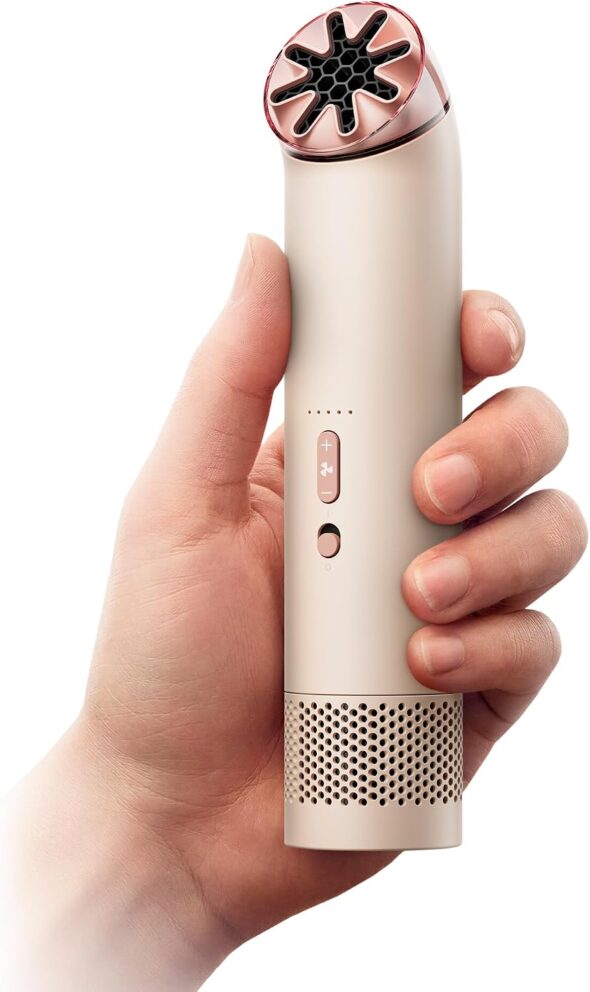
The Dyson company has went from innovative and expensive vacuums to overpriced mediocre products. I have an old Dyson Vacuum and last year I bought an overpriced Dyson Hair Dryer ($450!) which I have replaced with a much cheaper/better hair dryer. Long story short, I believe Dyson has grown to an innovative products company to an overpriced gimmicky products company. Now, on to their latest gimmicky product, the Dyson HushJet Mini Cool Fan ($99).
Dyson’s latest entry is a compact, rechargeable handheld personal fan. It’s ultra-slim (about 1.5 inches in diameter, 7-8 inches tall), lightweight (around 7.5 oz / 212g), and comes with accessories like a neck lanyard, charging stand, travel pouch, and USB-C cable. Key specs include:
- 5 speeds + Boost mode (up to 25 m/s or ~55 mph airflow from a 65,000 RPM motor)
- Up to 6 hours battery life
- 360° twist nozzle
- Claims of “quiet” HushJet air projection with honeycomb mesh to reduce turbulence
On paper, it sounds like a premium EDC (everyday carry) cooling solution for commutes, festivals, or hot offices.
Noise is the biggest letdown. Despite the “Hush” branding, reviews consistently call it surprisingly loud—especially past speed 2-3. Boost mode hits 77-80 dBA, and even mid-levels can sound like a high-pitched whine or hair dryer. That defeats the purpose for shared spaces, offices, or quiet environments.
Performance vs. price. It moves air powerfully for its size, but so do many $15-30 handheld fans on Amazon or alternatives like the Shark ChillPill (though that one’s pricier too). The narrow, focused airflow feels more like a personal air duster than a broad cooling breeze for some users. Battery life is decent but nothing revolutionary.
The Dyson tax. At $99, it’s positioned as accessible for the brand, yet critics argue you’re mostly paying for the name, sleek design, and accessories rather than breakthrough tech. This fits the broader pattern; innovative roots giving way to gimmicky, aspirational products.
Build and longevity concerns. Like other recent Dyson items, there are early complaints about feeling “cheap” under the premium exterior, plus the usual questions about repairability and long-term durability that plague the brand’s higher-end lineup.