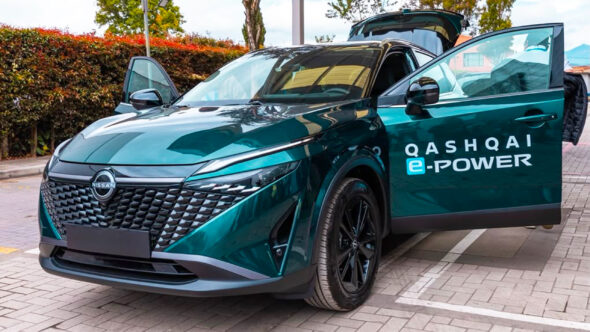
I have never been a “Nissan guy”. I am sure they make some good cars but I have always believed that Toyota and Honda were superior. Either way, props to Nissan for innovating in a big and important way – efficiency.
In a run across Colombia from Bogotá’s high-altitude streets to the Caribbean coast, a European-spec
Nissan Qashqai e-Power covered 1,230 miles (1,980 km) on a single 14.5-gallon (~55-liter) tank. Guinness World Records certified it as the longest journey by a non-plug-in extended-range electric vehicle SUV. The average worked out to an eye-watering 102 mpg (European) / 85 mpg (US). That’s the equivalent of Los Angeles to Dallas without stopping for gas or a charger.
This isn’t a conventional hybrid. In the series-hybrid e-Power setup, a 1.5-liter turbocharged three-cylinder gasoline engine never drives the wheels. It runs purely as an onboard generator, charging a compact ~2-kWh battery that feeds a high-torque electric motor. The wheels stay 100% electric-driven the entire time. This isn’t a new idea, others like the Mazda MX-30 R-EV, Ram 1500 REV, and Fisker Karma have all used this technology.
By decoupling the engine from the drivetrain, Nissan’s software keeps the gas engine operating at peak thermal efficiency. Extra smarts include a variable-compression turbo that switches between a high 14:1 ratio for max economy when cruising or at low demand and a lower 8:1 ratio (with turbo boost) when the electric motor needs big power. The system also listens for road noise—firing up the generator on rough or loud highways so you barely notice it, then shutting it off in quiet residential areas for pure EV silence. Software even tunes the engine note and revs to rise linearly with road speed, so it feels like a normal gas car rather than a generator humming away disconnected from your right foot.
One (huge) caveat on the record run: the route dropped thousands of feet in elevation, so regenerative braking (via the e-Pedal) harvested a lot of free energy on the long descents. Still, the numbers are impressive under real mixed conditions that included traffic and mountain roads.
For years Toyota and Honda have dominated the hybrid conversation in many markets, especially North America. Nissan leaned hard into pure battery EVs with the Leaf and Ariya, but plenty of buyers still want the convenience of gas stations without range anxiety or home-charging dependence. This record is a loud signal that the same e-Power tech is heading to the United States in the 2027 Nissan Rogue Hybrid, tuned with a specialized variable-compression engine for American highway speeds and targeting real-world economy north of 40 mpg.
Series hybrids aren’t unique—Honda’s e:HEV, Mazda’s rotary range-extender, the Ram 1500 Ramcharger, and various Chinese models use related approaches—but Nissan’s execution stands out for the seamless software masking, the variable-compression engine, and the focus on making the experience feel natural rather than industrial.
The result is the silent cabin, instant torque, and smooth regenerative deceleration of an EV, delivered without ever needing a plug. For drivers who want efficiency that actually moves the needle on fuel costs and emissions without infrastructure hassles, this is genuine innovation. Kudos to Nissan for pushing the format forward and proving the real-world capability in such dramatic fashion.
All that said and a couple of things come to mind – 1) couldn’t they find a better name than Qashqai and 2)who else remembers the 1985 Honda CRX HF that got 54 mpg on the highway with no magic hybrid or battery technology?