
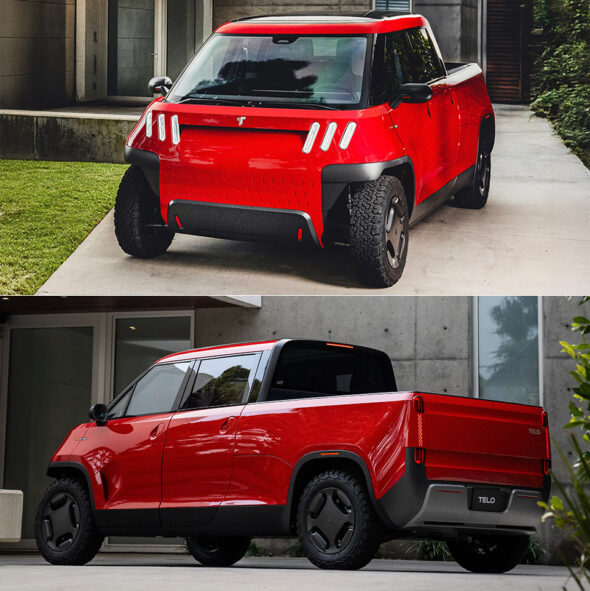
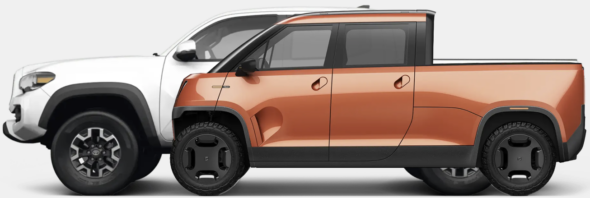
The TELO MT1 aims to solve a real problem: modern pickups have ballooned into parking-lot monsters while many buyers just want something that can haul plywood, seat a few people, and still fit in a city garage. At 152 inches long, 73 inches wide, and 67 inches tall, this all-electric four-door crew-cab pickup claims the interior space and 60-inch bed length of a Toyota Tacoma (extendable to 96 inches via midgate for 4×8 sheets with the tailgate up) inside the overall length of a two-door Mini Cooper SE. It seats five standard (up to eight with a third-row setup using the under-bed storage tunnel as a footwell), offers 10 inches of ground clearance, and targets an estimated 260 miles (77 kWh pack) or 350 miles (106 kWh long-range pack).

Single-motor rear-drive versions make about 300 hp and hit 0-60 mph in a claimed 6 seconds. Dual-motor AWD versions jump to 500 hp and roughly 4 seconds. Fast charging is quoted at 20 minutes for 20-80%. Pricing starts around $41,520 for the base single-motor standard-range model, climbing toward the high $40ks or low $50ks once you add dual motors and the bigger battery. Production is targeted for late 2026 (low initial volumes via a contract manufacturer), with first deliveries of a few hundred units hoped for around then.
On paper, it’s a clever packaging exercise that has already attracted real prototype drives, journalist impressions, and thousands of reservations. The website is polished, the Discord community is active, and the pitch—“Toyota Tacoma capability, Tesla-like range and efficiency, in the footprint of a MINI Cooper”—is catchy. Yet a closer look reveals some goofiness that undercuts the slick marketing.
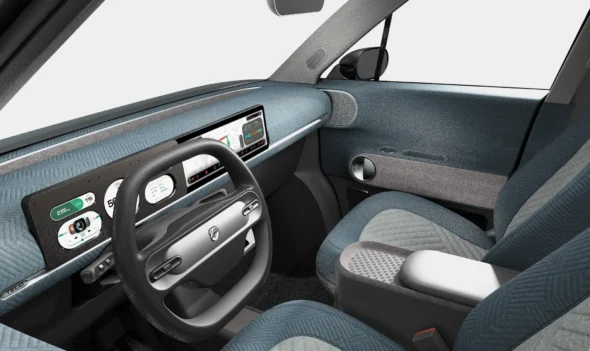
Sparse “real” photos and CGI vibes
Scroll the official site and you’ll notice a heavy reliance on polished renders, diagrams, and video placeholders rather than abundant real-world photography. Prototypes exist—journalists have driven them, events have shown them, and there are legitimate exterior shots floating around—but genuine production-intent imagery is thin. Interior photos are especially scarce; the few that appear lean polished and somewhat synthetic, prompting the reasonable question of how much is still conceptual or AI-assisted visualization versus finished hardware. For a vehicle supposedly months from customer deliveries, the visual scarcity feels odd.

Towing 8,000-lbs… with a 1,700-lb payload
The dual-motor AWD model now claims an 8,000-lb towing capacity (recently raised from the earlier 6,600-lb figure after real-world testing). That’s impressive for a truck that weighs roughly 4,400 lbs and is shorter than many midsize sedans—it puts the little TELO roughly on par with a base gas F-150 in raw pull.
The payload, however, drops to a modest 1,700 lbs on the dual-motor version (2,000 lbs on the single-motor). That imbalance is classic physics: the motors and hardware that enable high towing also eat into cargo capacity. The practical warning writes itself—keep that trailer tongue weight low and the load carefully balanced, or you’re quickly exceeding the payload while still legally “within” the towing number. It’s the kind of mismatch that invites careful reading of the owner’s manual and a healthy dose of skepticism about real-world trailer life.
Tonneau covers, camper shells, and solar from a fellow vaporware neighbor
Accessories include a tonneau cover and camper shell, both available with solar options supplied by Aptera. The idea is appealing: panels on the cab roof, tonneau, or full camper shell generating free energy while parked. Claimed output is up to 200 watts peak per panel, or roughly 1–2 kWh per day depending on location and season. Given the TELO’s claimed efficiency (around 200–300 Wh/mi), that might translate to a handful of free miles daily under ideal conditions—useful for trickle charging or extending off-grid time, but hardly transformative for a 106 kWh pack.
What’s missing are hard real-world numbers: exact system wattage for each option, how (or whether) the solar prioritizes the high-voltage traction battery versus 12V systems, degradation in partial shade or dirt, and actual daily contribution under average U.S. conditions. Compounding the uncertainty is the partner itself. Aptera has spent years promising its own highly efficient solar three-wheeler without delivering customer vehicles. Pairing one pre-production EV startup’s accessory strategy with another’s unproven hardware is a bold choice that amplifies the “this still feels early” atmosphere.
Look, I hate to be so harsh here but I have been waiting for my Aptera since 2006. Since that time, Aptera has gone bankrupt (2006-2011) – relaunched as a Chinese backed venture (2012-2014) – and are back at it again (2019-2026). I have to give them props for tenacity but not so much for execution and delivery. All that to say, this is the solar panel supplier for Telo. SMH.
Slick marketing with a Kickstarter aftertaste
The website and messaging are professional and community-oriented. Reservations are fully refundable and held in escrow. Prototypes have been built, driven, and publicly shown; funding has been raised; a contract manufacturer is involved. This is further along than pure vaporware. Still, the overall presentation—ambitious claims, limited transparent production photos, evolving specs (towing recently jumped), and years of pre-orders without a finished production truck on the road—carries a familiar startup-EV scent. Many similar projects have delayed, scaled back, or quietly faded. TELO appears more tangible than most, but the gap between glossy promise and delivered metal remains.
The $152 reservation
Finally, the deposit itself: a fully refundable $152. Not $150, not $200, not a round $100. The company openly states it references the truck’s 152-inch overall length. It’s a cute branding touch that also keeps the barrier low and the number memorable. Arbitrary? A little. Harmless marketing? Mostly. Still the sort of detail that makes you smile and roll your eyes at the same time.
The TELO MT1 remains one of the more interesting compact EV truck concepts out there. If the packaging, efficiency, and claimed capabilities survive production and real-world testing, it could carve out a useful niche for urban owners who still need occasional hauling and towing. Until metal starts rolling off the line in meaningful numbers, though, the mix of genuine cleverness and lingering goofiness keeps the healthy skepticism dial turned up.
I honestly would buy this vehicle if a quality version of it gets to real-world production. I am just a bit gun shy and was “triggered” (I hate that word) when I saw one of their manufacturing partners was Aptera as I have personal history on the bench here.
Worth watching closely—just don’t hitch the fully loaded trailer quite yet.