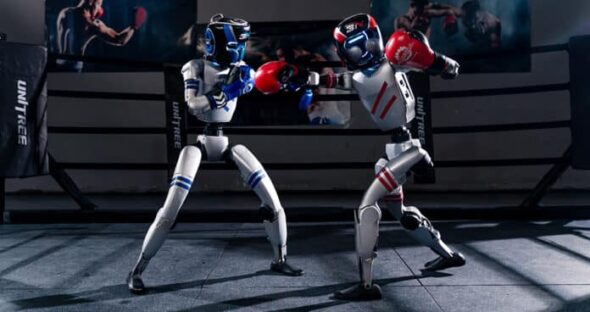
The second World Humanoid Robot Games kicked off on August 21 at Beijing’s National Speed Skating Oval, and the action is already delivering serious gadget-geek thrills. With 666 teams fielding more than 2,000 humanoids competing in 30 events (plus demos and showcases), this five-day spectacle is less pure sports spectacle and more a high-stakes product showcase for the next wave of bipedal robots. And yes, there really are 666 teams. Creepy right?
The headline grabber so far? Honor’s humanoid Lightning smoked Usain Bolt’s long-standing 100-meter world record. The robot crossed the line in 9.32 seconds—faster than Bolt’s 9.58-second mark that no human has touched in 17 years. This comes after Honor bots already impressed earlier in the year at a Beijing robot half-marathon, earning praise not just for pace but for smooth gait and overall design. Those refinements matter: the industry is moving past “can it walk without falling?” toward polished, athletic movement that looks closer to real-world usefulness.
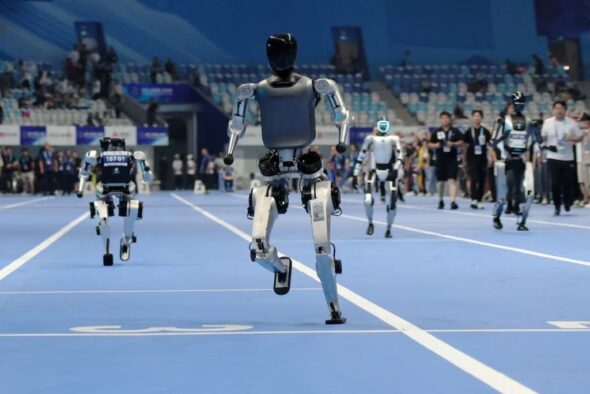
Shanghai-based MirrorMe brought its own contender, the Bolt. Standing 175 cm (about 5’9″) and weighing 75 kg (165 lb), this sprinter hits 11 meters per second. MirrorMe CTO Jin Yongbin notes that raw speed is really a test of engineering limits—power, durability, balance, and fluid motion—while forcing teams to study and adapt biological movement principles.
What makes these machines interesting from a gadget perspective is the ecosystem enabling them. Chinese companies are leveraging mature automotive supply chains for motors, batteries, drives, and transmissions, then applying that hardware know-how directly to humanoids. Phone and EV makers branching into robots isn’t unusual there; the shared parts and manufacturing base accelerate iteration. Events like these games plus data-sharing initiatives encourage engineers to swap insights across company lines, speeding up refinements in locomotion, design, and reliability.
The result is a crowded field of teams pushing humanoids that look increasingly ready for practical roles—whether factory helpers, research platforms, or eventual consumer companions. While full household humanoid gadgets remain a ways off, the rapid year-over-year progress visible at these games (compare the 2025 highlights to what’s showing up now) shows how quickly balance, speed, and form factor are improving.
Companies like Unitree and UBtech continue competing hard for domestic and export markets, but the broader environment supports hundreds of teams building and testing at once. For gadget watchers, that’s the real story: not just one record-breaking sprint, but a pipeline of increasingly capable bipedal machines that could influence everything from warehouse automation to the personal robots of the late 2020s.
Lightning’s dash and Bolt’s presence are fun spectacles, yet they underline how far humanoid hardware has come in a short time. Keep an eye on the rest of the events—the next breakthrough in gait, endurance, or dexterity could be the one that starts bridging the gap from competition arena to everyday tech. What could go wrong?