
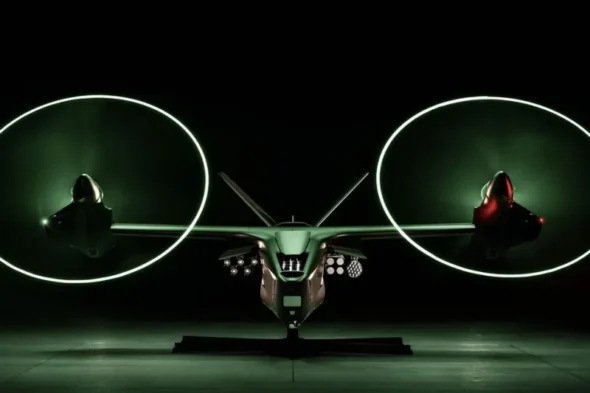
At the 2026 Farnborough International Air Show, defense technology company Anduril Industries—working with Archer Aviation—unveiled its latest innovation: the Thunder. This Group 5 autonomous tiltrotor drone is designed specifically as a “loyal wingman” for crewed attack helicopters, promising to transform low-altitude combat operations.
Helicopters Need Wingmen?
While loyal wingman drones are becoming more common for fixed-wing fighters, attack helicopters like the AH-64 Apache face growing dangers from enemy drones and advanced air defenses in contested low-altitude environments. Thunder addresses this by taking on high-risk missions, allowing expensive manned platforms and their crews to stay farther from the most dangerous zones while dramatically boosting overall combat effectiveness.
Compact, Powerful, and Versatile
Thunder is notably smaller and more transportable than traditional attack helicopters. Weighing just over 1,320 lb (599 kg), it can fit inside a standard shipping container, making it highly deployable. Despite its compact size, it delivers serious firepower through a modular payload system that supports:
- Up to 10 air-to-ground missiles (including Hellfire and Barracuda-100M variants)
- 16 air-launched drones
- As many as 76 70-mm rockets
- 12 counter-drone weapons mounted in the nose
- Additional options for precision munitions, electronic warfare systems, or general cargo
The aircraft uses a series-hybrid-electric powertrain paired with Optimum-Speed Tiltrotors (OSTR) that feature variable rotor speeds. This setup provides excellent maneuverability, efficient cruise performance, and the ability to operate quietly in nap-of-the-earth flight profiles.
Anduril claims that a single attack helicopter supported by three Thunders could deliver triple the combat power of a conventional setup—at a significantly lower overall cost.
Development Status
A surrogate aircraft has already logged numerous successful test flights. Anduril expects the full prototype to take to the skies in 2027.
A New Chapter in Attack Aviation
Thunder represents a practical step toward mixed-crewed and uncrewed helicopter teams. By combining vertical takeoff and landing (VTOL) flexibility with substantial payload capacity and autonomous capabilities, it could help modern forces maintain air superiority in increasingly lethal battlefield environments without putting more pilots at risk.
