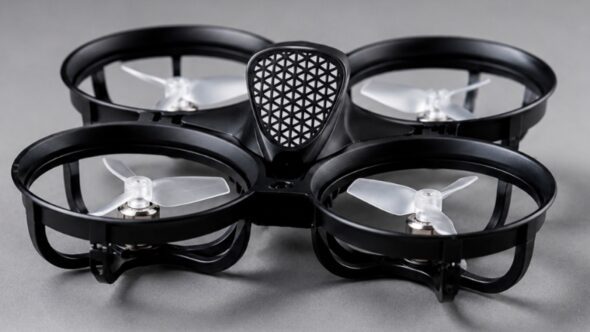
Hard to believe but true – Mosquitoes rank among humanity’s deadliest foes, spreading diseases that kill hundreds of thousands each year while turning backyard evenings into itchy nightmares. Traditional defenses—sprays, zappers, and nets—often fall short or rely on chemicals. Enter Tornyol, a Y Combinator-backed French startup building a 40-gram autonomous micro-drone that patrols your space, detects mosquitoes by their unique wingbeat “signature,” and neutralizes them in mid-air using nothing more than its spinning propellers.
Silent, chemical-free, and designed for continuous operation, the
Tornyol system promises a smarter way to reclaim your home or garden. It’s not shipping yet—U.S. deliveries are targeted for 2027—but the company is accepting $100 refundable deposits to secure a spot in line.
How the Mosquito-Hunting Micro-Drone Works
Tornyol combines ultrasonic sonar with intelligent control algorithms. A base station (or related LeSonar-style phased-array system with hundreds of smartphone-grade microphones and an FPGA processor) maps the environment in 3D using ultrasonic pulses. It listens for echoes and identifies the distinctive micro-Doppler signature created by a mosquito’s rapid wingbeats—potentially distinguishing females (the biters) from males and other insects like bees or moths.
Once a target is confirmed, the lightweight drone launches, intercepts it mid-air, and eliminates it through physical collision with its high-speed propellers. The drone then returns to its base station to recharge and relaunch for 24/7 coverage. No chemicals, no messy traps—just autonomous patrols that hold the zone.
Users define the protection area via a simple map on the base station; no complex installation or wiring is required. Early claims suggest a single unit could cover outdoor or indoor spaces up to around 5 acres, though larger areas would use multiple drones (the company has floated the idea that about 10 could clear a square kilometer).
Current prototypes offer roughly three minutes of flight time per charge (hopefully flight time is much longer in final version), followed by about 30 minutes of recharging, with the system managing schedules for continuous protection. Detection ranges in testing have reached up to about 8 meters (26 feet).
In mid-July 2026, co-founder Alex Toussaint (a former MBDA missile engineer) shared video of the drone’s first successful mid-air interception—of a moth in a controlled test environment. While not yet a mosquito in open air, the autonomous pursuit and neutralization marked a major step “towards completely eradicating mosquitoes,” according to the team. The system is progressing toward fully embedded hardware for greater independence.
The approach draws inspiration from parking-assist ultrasonic sensors and advanced digital signal processing, transforming what started as modified toy-drone platforms into precision hunters. Founders Alex Toussaint and Clovis Piedallu emphasize the broader potential: dramatically lowering the cost of mosquito control (claims of up to 100x reduction) and aiding efforts against malaria and other vector-borne diseases.
Specs, Pricing, and Availability
- Weight: 40 grams
- Core tech: Ultrasonic sonar (including phased-array elements with hundreds of microphones), onboard or base-station signal processing, intelligent flight control
- Operation: Autonomous patrol, detect-and-intercept, self-return to charge
- Key advantages: Silent, safe for people and pets in normal use, chemical-free, works in low light
Pricing options after the deposit: a one-time purchase around $1,100 for full ownership, or a $50-per-month subscription (cancellable, with return of the device in good condition). The $100 deposit is refundable and simply holds your place for expected 2027 U.S. shipping.
The product remains in development, so real-world performance, battery improvements, weather resilience, and exact coverage will be refined before launch. Early tests validate the detection and interception concepts, but full outdoor mosquito eradication at scale is still the longer-term goal.
Tornyol sits at the intersection of consumer robotics, advanced sensing, and practical problem-solving. It’s the kind of clever engineering that turns everyday annoyances (and serious public-health issues) into opportunities for autonomous systems. If the tech delivers, summer nights without the constant buzz—or the need for chemical sprays—could become the new normal for early adopters.