
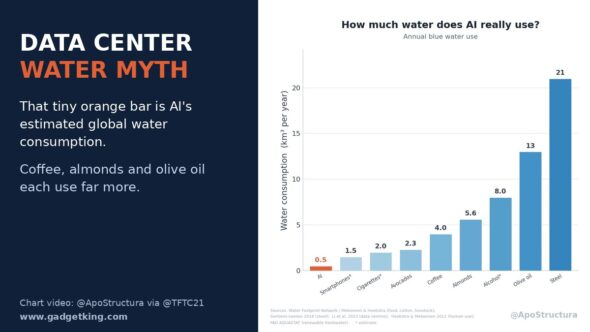
Every few weeks a new post goes viral claiming the data center going up down the road is about to drink the town dry. I rebuild computers for fun, so I get why the idea sticks. Servers run hot, and hot things need cooling. But when you put the actual numbers side by side, the “data centers are draining America’s water” story shrinks fast. It ends up about the size of the orange bar in the chart below.
TFTC (@TFTC21) posted this comparison on November 11, 2026, along with a short chart animation by @ApoStructura. Hit play and watch the AI bar disappear as the scale grows.
US water use per year:
Data centers: ~17 billion gallons
Golf courses: ~500 billion gallons
Farm irrigation: ~27 trillion gallons— TFTC (@TFTC21) November 11, 2026
Two different things are going on in that post. The caption gives US numbers in gallons. The video is a global chart in cubic kilometers, and it has nothing to do with golf. I checked both, separately.
The US numbers check out
Here is how the three caption figures hold up against the official sources:
- Data centers, ~17 billion gallons: Correct. The Department of Energy’s Lawrence Berkeley National Laboratory estimates US data centers consumed about 17.4 billion gallons on site in 2023, mostly for cooling (LBNL 2024 report).
- Golf courses, ~500 billion gallons: A little low, if anything. The golf superintendents’ own survey says US courses applied about 1.68 million acre-feet in 2020 (GCSAA). That works out to roughly 547 billion gallons.
- Farm irrigation, ~27 trillion gallons: This matches irrigation consumption, meaning the water that evaporates or gets used by crops and doesn’t come back. The USGS puts that at 73.2 billion gallons a day, about 26.7 trillion a year. Counting total withdrawals, irrigation pulls 118 billion gallons a day, which is about 43 trillion a year (USGS, 2015 data).
| US use (per year) | Gallons | vs. data centers |
|---|---|---|
| Data centers, on-site (2023) | ~17.4 billion | 1x |
| Golf courses, applied (2020) | ~547 billion | ~31x |
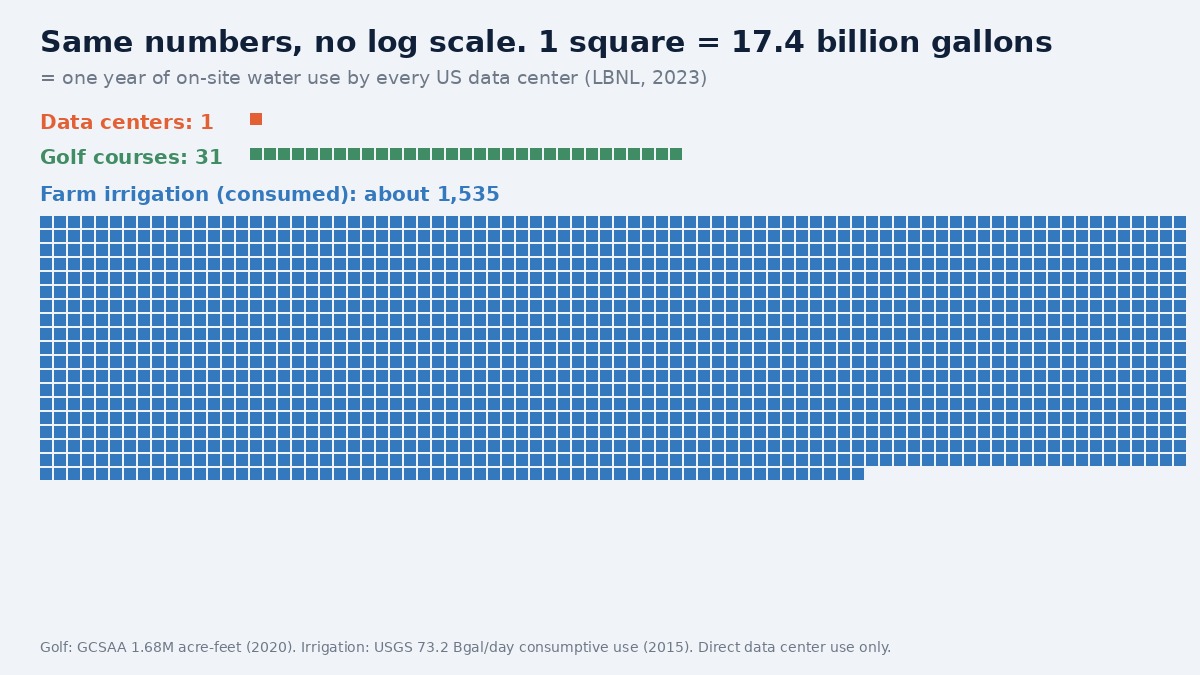
| Farm irrigation, consumed (2015) | ~26.7 trillion | ~1,535x |
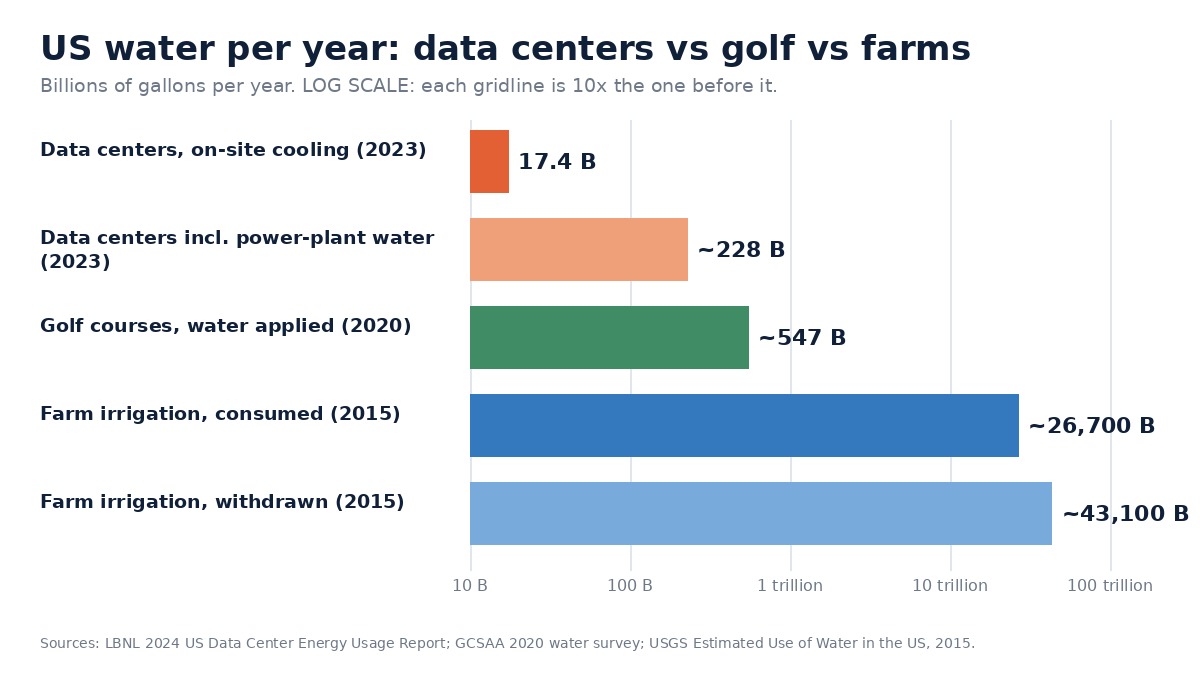
Log scales can make a gap look smaller than it really is. So here is the same comparison drawn to linear scale, one square at a time:
Some handy comparisons
- US public water systems deliver about 39 billion gallons a day (USGS). A full year of on-site data center water is about 11 hours of that.
- Americans use nearly 9 billion gallons a day outdoors at home, mostly on lawns and landscaping (EPA WaterSense). That means our yards burn through a year of data center cooling water in about two days.
- The National Institutes for Water Resources says 17.4 billion gallons is about what 160,000 US households use. It’s also roughly the water needed to irrigate 71,000 acres of Nebraska corn (NIWR).
And the video?
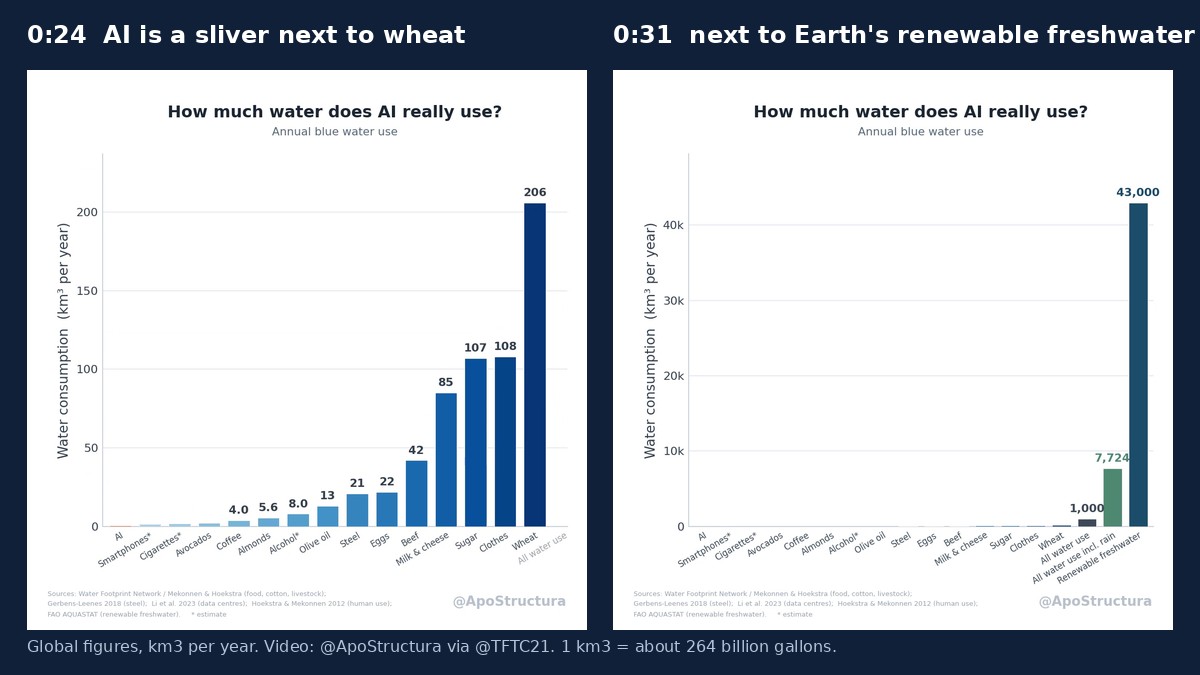
The @ApoStructura animation shows global water consumption per year. It credits Li et al. 2023 for its AI bar of 0.5 cubic kilometers, which is about 132 billion gallons. That lines up with the paper’s projection for 2027: 0.38 to 0.60 billion cubic meters of global AI water consumption, and that range already counts the water used at power plants (Li et al.). Stack it up against coffee (4.0), almonds (5.6), beef (42) or wheat (206) and the AI bar is basically a rounding error. Next to roughly 1,000 cubic kilometers of total human water use, it’s about 0.05 percent.
The fair points (because there are some)
National totals don’t settle every local fight. A big evaporative-cooled campus can use up to a couple million gallons a day, and its demand spikes in summer. In a drought-stressed area, that can strain a small utility (NIWR). Data centers also use water indirectly through the power plants that supply their electricity. LBNL estimates that indirect share at about 211 billion gallons in 2023, much more than the on-site number. Even then, golf still comes out ahead, and farms aren’t remotely close. Growth is real too: LBNL projects that on-site use could double or even quadruple by 2028.
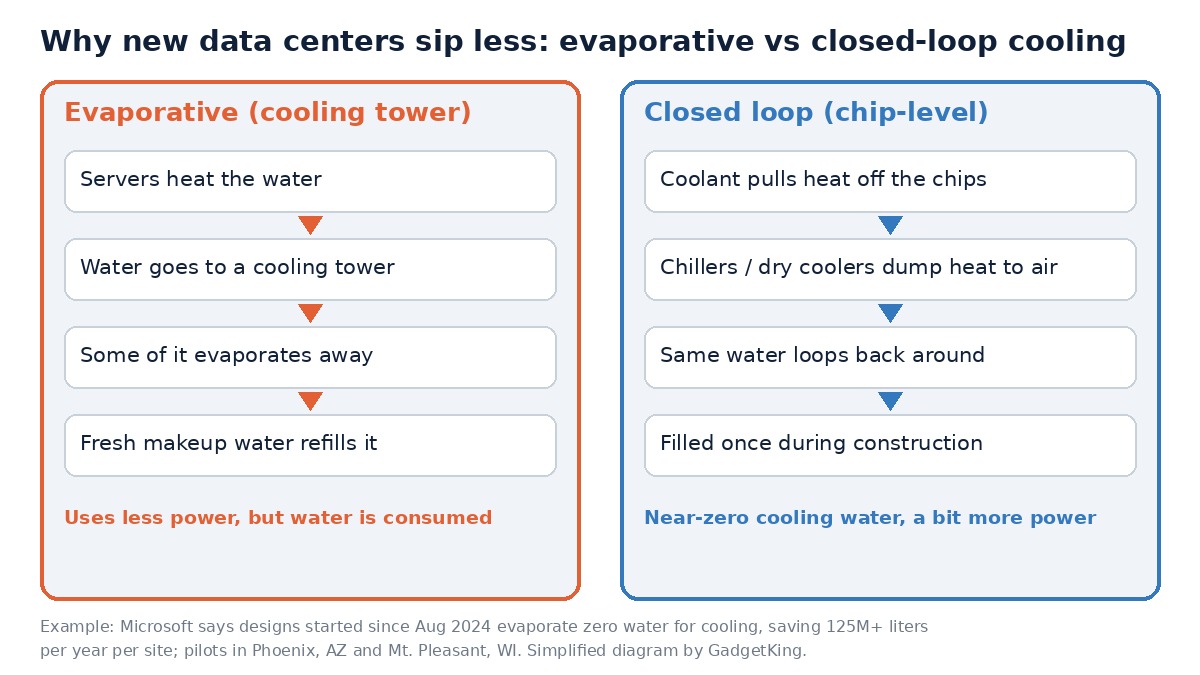
The industry is also moving away from evaporating water at all. Microsoft says every data center it has designed since August 2024 uses closed-loop chip-level cooling that evaporates zero water for cooling. That saves an estimated 125 million liters or more per site each year, with pilots in Phoenix and Mt. Pleasant, Wisconsin. It also runs some existing sites on reclaimed water (Microsoft).
The bottom line
Asking where a new data center gets its water and power is fair. Ask the zoning board about cooling design, reclaimed water and summer peak demand. But the idea that data centers are a giant national water hog doesn’t survive a calculator. If we’re looking for the big straws in America’s water glass, they’re on the farm and on the fairway. That’s not a knock on farmers or golfers, either. Food matters, and a good back nine is good for the soul. It just means the server rack is not the villain here.
Want more of the hardware behind all this? Browse our Computing coverage.
